Sunday, 5 June 2011

A little list of Gilbert and Sullivan exploits!

Roll up Roll up, Ladies and Gentlemen, Attention Please Attention if you please! I present you with my G&S history, in pictures!

The Yeoman Of The Guard – 2002

In 2001 I helped out with Pirates, but that was before the invention of cameras. 2002 saw me take to The Boards for the first time ever, as a Yeoman – Not only was I considered too tall to be a girl, but the tall girls were split, with the taller half being Yeoman and the middle half being men. Shy and quiet and largely unable to sing, Yeoman was certainly a new experience, but remains one of my favourites. For anyone interested, the school reinstated ‘Laughing Boy’ and ‘Jealous Torments’ but retained the cut of ‘Rapture Rapture’ – which I for one am only too grateful for. See how many other familiar faces you can find on this cast photo:


The Mikado – 2003

Slightly older and slightly less shy, in The Mikado I was male chorus, had two wives, and carried a banner as part of the Mikado’s train. Start small, as they say. Digital cameras had been invented by then, so here is me sporting full Japanese attire, and yes, those are tights on my head.


Iolanthe – 2004

In Iolanthe I was the tallest person in the cast, and as some sort of bizarre reward for this achievement, was the only member of the Peer’s chorus in blue, thus identified easily from miles away. Intriguing costuming decisions saw us wearing white bloomers with shirts tucked in, and personal pride rendered my mustachios the largest and most impressive around. I even took public transport home while wearing it. That, ladies and gentlemen, is style.


Ruddigore – 2005

My first principal part. For those of you familiar with the story, Old Adam is a great little part for a character actor and was a good part for me to get started on. Racked with nerves, I made mistakes with the singing every night, but thoroughly enjoyed the experience. Especially getting my costume ripped on stage, and terrorising the female chorus with a stuffed rat, and fake-crying really loud during the leading lady’s solemn second act solo. I also got measured for my costume standing on a chair in the headmistress’ office in the middle of one of her important meetings, having spent all afternoon in the pub. Ruddigore also saw the start of that infamous school nick name – ‘ugly old moron’ – those were the days.


The Gondoliers - 2006

My last year in school was emotional for many reasons, but none more so than that I was forced to leave the comforting grasp of the Opera. Playing Don Alhambra was fantastic, Gilbert did, after all, write his finest roles for men, and not many women can boast of having played them. Several large solos and countless libretto lines later, on the last night I was so distraught at the prospect of leaving that I cried all the way through the final scene, and positively collapsed after the customary last night speech. Which was a shame really, as I had been partly responsible for re-writing the end-of-show song that year and didn’t get to enjoy any of it! (I will endeavour to find and replicate said song one day). Here I am, gloriously grey:


HMS Pinafore – 2007

The established G&S society was one of the reasons I decided to go to Hull University, and I was lucky enough in my first year to secure a good part with a promising young cast around me – the HUGSS society enjoyed a large influx of members in 06/07, among them a full suite of G&S principal performers – soprano, alto, tenor, baritone, comic lead, bass - meaning that Pinafore, although raw in presentation, allowed performers good creative flow, and set the foundations for lasting friendships. Here is me, resplendent in my first ever female role:


Iolanthe - 2008

My second Iolanthe, this time as a principal. Fairy Queen Kayleigh was also President Kayleigh, aptly termed by the director in his ‘Thank You’ card after the show ‘Lord High Everything Else’. I got involved with everything possible and probably largely compromised my final degree grades by throwing myself into the part with such ardour. Nice costume this year, a little bit sexy is a good look for the Queen I think. My favourite bit of the show was almost definitely being given japanese ‘kabuki’ streamers to play with at the end of Finale Act 1 – amazing!
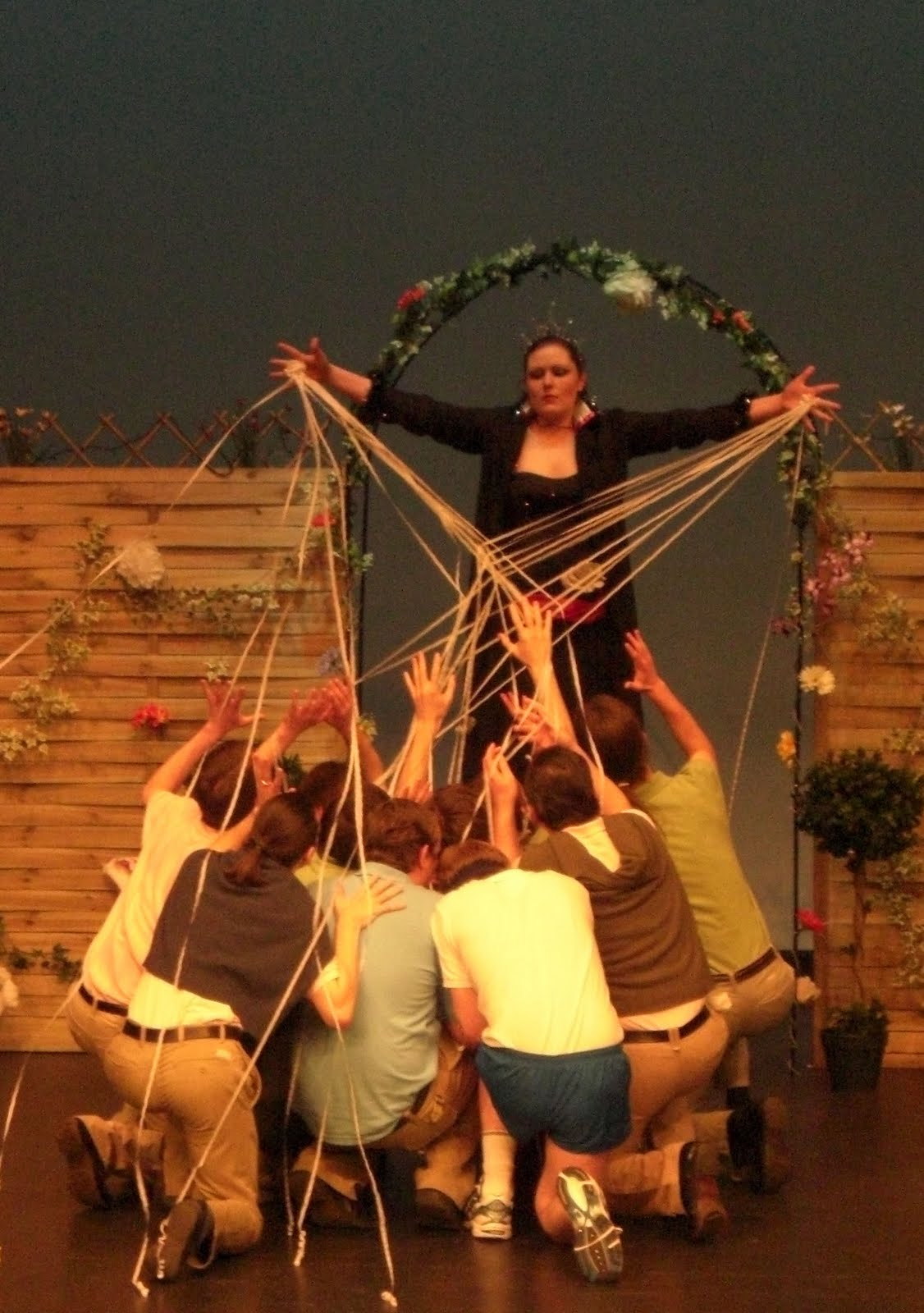

The Pirates of Penzance – 2009

My first role in Pirates, and not an attractive one – directorial vision saw Ruth in men’s clothing, having obviously worn out her female attire while living with the pirates. The overall effect was brilliant, with all the pirates in tweed - but I doubt I will ever have a less attractive costume! The show was largely set in the 50’s with swing skirts, beach huts, bright colours and my little brother playing the (Geordie) Sergeant of Police. We also won the ‘Best Society Event’ award from the University for our efforts! Two pictures here, to show you my rather hideous main costume, and also my make-over costume for the end of the finale:


The Mikado – 2010

After being forced to leave University (bad times indeed) I reluctantly sought G&S action elsewhere – and became a member of St Andrew’s in Roker. The Mikado was the first time I had ever played a ‘young’ girl, which I found ridiculously hard to adjust to – and the show run was the longest I had done to date (6 nights including Dress). Playing Pitti-Sing was also the first time I had acted with appropriate aged principals; the three maids and Nanki-Poo were passing young enough, and the other characters were passing old enough to be real adults. Overall a brilliant experience, which also set my directorial ambitions in motion.


The Gondoliers – 2010

Words cannot describe how simply amazing my experience at Buxton was. Invited to Buxton with SavoyNet Performing Group to sing in the Opera House, ‘Tessa’ was my biggest and most difficult role to date, having to take on the ‘romantic’ leading lady for the first time ever. I couldn’t have asked for a better Guiseppe, more enjoyable rehearsals or a fuller Opera House (sold out!). Audience members actually cried in the emotional exit of Marco and Guiseppe at the End of Act One, and I discovered that actually I can dance quite well!


Ruddigore – 2010

The oldest role I have played to date, Dame Hannah is clarified from the off as an ‘old’ character, so I found it quite difficult to effect this, being barely twenty two. Still, I gave it a good go, donning prematurely greying (but visibly still red underneath) matron hair, wrinkles and a stern Scottish accent. High point of this one – being dragged through the audience with a sack over my head, screaming!


Iolanthe – 2011

My second role with Roker, my second Fairy Queen and my third Iolanthe – I definitely knew all the words this time. My Fairy Queen this time took a much more childish direction, channelling ‘Queenie’ from Blackadder, as she led the Suffragettes to victory (enjoyable insertion: The Soldiers Of Our Queen from Patience, but to the words ‘We are the Suffragettes/We fight for equal status’). I had the most amazing costume I have ever encountered and was absolutely devastated to have to give back, and enjoyed building on friendships formed during Ruddigore. Here is me, commanding the stage, as it were!
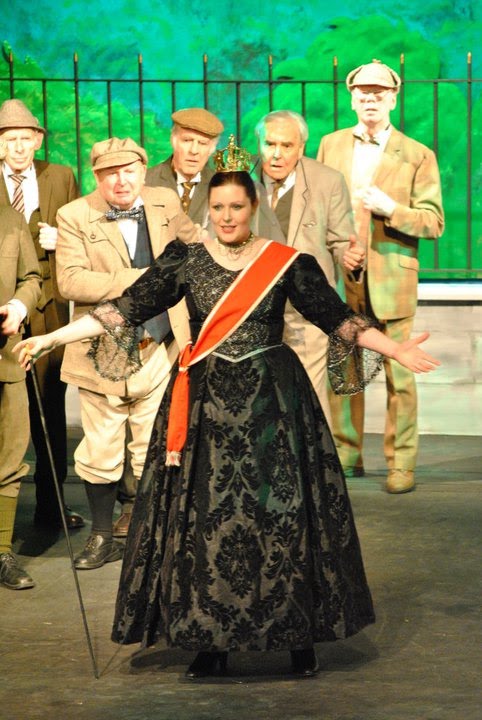

The Grand Duke – 2011

Every G&S collector needs a ‘Grand Duke’ under their belt and I was lucky enough to be invited to become a member of Newcastle University G&S for the privilege. Working with students again was absolutely brilliant, and The Grand Duke presented opportunity to get involved with makeup and costumes again, as well as making lots of lovely new friends. Baroness von Krackenfeldt is amazing fun to play (especially in this interpretation) – highly strung and thrifty in Act One with Rudolph, angry and haughty in the fantastic Act 2 entrance with Ludwig and Julia, and in this, the opportunity to be a delightful drunk, throwing glasses of champagne over an unlucky chorus before marrying the strapping Prince of Monte Carlo. Theatrical Bliss!


HMS Pinafore – 2011

Yet to reveal the finished spectacle, I wont go into too much detail about Pinafore – but a full account of my first directorial project will no doubt follow. Directing is fun despite the stress, and playing my own Buttercup gives a sense of freedom which I haven’t encountered in anyone else’s theatrical vision. That, and I get to stand in for anyone who is currently missing, so a myriad of characters is always eager to get out! Here is me being Sir Joseph Porter in rehearsal:


And that, devoted readers, is that! More information on any of the above is available on request should you ever want it (unlikely) but I leave you now to attend to Pinafore business. One day I might even branch out to performances which aren’t G&S, though still high on the ‘To Do’ list are Phoebe in Yeoman, Lady Psyche in Ida, Lady Jane in Patience and one of the twins in Utopia. But anyway, to business - I go, I go – look how I go! Swifter than an arrow….

Monday, 28 March 2011

Hundreds of amateurs, half empty audiences - why?

The north-east amateur dramatic scene is always busy, as I am sure it is in other areas of the country. However, every society out there has been standing on the stage facing a half-empty audience at some point in their theatre career. It did previously strike me as very odd that the musical dramatic types didn’t band together and help each other out now and again to create allies and a fall-back support net; after two years of experience, this has become mildly infuriating.

All societies are always looking for male members. Always. Bar none. They are quite often also always looking for YOUNG members. Now, within the confines of the Gilbert and Sullivan Societies of the North East at least (though I am sure it applies to a good many others), why cannot the major societies get together sometimes and discuss their show and rehearsal dates? If they could swallow their competitive pride enough for this to happen, we might actually get somewhere. Performances being spaced out around the calendar, without clashing rehearsals, would give anyone who wanted to be involved with more than one society the time to do so without ruining their own lives with incessant rehearsal, thus sharing out the male/young talent pool and preventing the stagnation of unsuitable performers. I am already sufficiently jaded enough to know that this will never happen. But it is nice to consider the possibilities.

The biggest issue I find within the NE societies is support (or lack thereof) for each other’s performances. While at University the creative groups supported each other without much encouragement; the fierce competition between the societies and departments was suspended temporarily in a movement of support and curiosity, resulting in a full audience for those playing. Even if all it meant was that you, the audience member, could be justified in belittling the dramatic efforts of a rival, because you had paid, sat through the show, and earned your opinion. In the NE creative groups might have one or two links with other societies, but by and large will have absolutely nothing to do with one another. Now this is very unfair. Numerous times I have sat through performances which were absolutely piteously ridiculous, in the name of ‘local support’ – but where are the members of their society when the curtain goes up on our shows? Did the local groups ever support one another? This anti-support movement must have started with someone similar minded to myself wondering why they bothered themselves to stew in the cringe worthy boredom of local society events for no return, and giving cause to an uprising against it. Or perhaps way back when these groups were formed it was forbidden to fraternise. Who knows. Perhaps in future I will withhold my support for those who I feel would benefit from it; but how would I ever know who was worth supporting if I didn’t attend the shows?!

Don’t get me wrong, support between some of the G&S groups is quite consistent through the concentrated efforts of some individuals, but between the G&S groups and most of the more mainstream Musicals Groups, virtually nothing exists. The least these people who consider themselves to be at the top of the am-dram/musical food chain could do is ‘Maybe’ attend rather than ‘Not’ attend on Facebook. I mean come on. We all know you are too puffed up with your own self importance to sink to the level of actually coming, but it wouldn’t cost you anything to pretend.

Rant over.

For today at least :)

Thursday, 3 February 2011

Temporary Pauses

Quite, quite often, I forget about this blog. I have seen many many shows since the last one and have forgotten to create anything about them. How irritating. Perhaps from now on I might remember, and even once of twice publish retrospectively...just in case the mood strikes anyone to read it :)

Monday, 8 March 2010

Singing Choruses in Public - Its G&S I think!

Hull University Gilbert and Sullivan Society have, for the last few years, prided themselves on being able to produce energetic, enthusiastic and enjoyable versions of the G&S Operettas with a different twist to each rendition. In the eagerly anticipated Tim Burton style production of Ruddigore, the cast of 2009/2010 have certainly not dropped the ball.

Ruddigore is Gilbert’s satire of Victorian Melodrama, and the gothic elements in the plot (witches, curses, dead ancestors) make a good marriage with Tim Burton’s dark, dingy style. Director Lucy Thomson-Smith excelled herself in bringing a large and diverse cast into line with this vision, resulting in an entertaining and light hearted production.

The set for Act I of Ruddigore tore away from the usual Cornish Village to see the characters in a minimalist, monotone space, not dissimilar to the empty village in Burton’s The Corpse Bride. Resplendent in pale rags, the female chorus worked well as an eerie unit, and in their contrasting rich black the male chorus more than compensated for their lack in number with their enthusiasm and ability. Of the capable principle line-up, Lisa McKinley’s crazed and flirtatious Zorah was always a pleasure to watch. Fiona Murray’s Mad Margaret defied some of the traditional stigma of the part by being identifiable; her madness was reasonable within her story and made the audience laugh without having to resort to pure absurdity. HUGSS veteran Rory Oliver’s booming entrance in Act II grabbed audience attention, well supported by the male chorus and fantastic life-size paintings of the Ruddigore ancestors.

Thomson-Smith’s direction was carried well by the cast; perhaps not to the tastes of a die-hard G&S traditionalist but carefully striking the balance between maintaining the integrity of Gilbert’s original intentions and bringing to life an exaggerated element of character and setting. Her direction for the usually dull penultimate number (‘There grew a little flower/Sing hey lack-a-day’) was beautifully sad, marrying Oliver’s strong bass with Rose Kirven’s sweetly emotional contralto to a poignant dance sequence. At several points the audience lost interest in the main action of the lead characters in favour of a humorous background interlude, which could be seen by some as a weakness – but when evaluating audience enjoyment versus audience understanding, G&S quite often proves too tangled for the latter and so here the former is a welcome relief.

Amateur productions are often hampered by a lack of financial resource or a very wooden and stuffy approach, but congratulations must be duly awarded to cast, committee and orchestra alike for an enjoyable evening, showcasing some genuine talent in many of the young performers, and bringing Gilbert’s ghosts and some of Sullivan’s most dramatic music alive once more.

Sunday, 23 August 2009

A Facebook Don't

FACEBOOK THE MUSICAL
Edinburgh Fringe Festival 09
www.facebookthemusical.com

One could be forgiven for thinking that Facebook: The Musical would be about Facebook, that it would be a clever and insightful idea given Facebook’s current popularity, and that it would be an interesting show. Sadly, it did not quite fit this bill, due to falling far short of the marker.

Starting with a relay of ‘status updates’ about the five different characters to set the scene, the action did not take long to get going, but it was soon clear that the story didn’t have a lot of relevance to Facebook. In fact, it was almost possible to omit Facebook entirely from the show, and do it no real damage. The show was over long and tedious in places, and there was little real wit involved in the writing. More than one audience member resented paying £9.50 to be exposed to a plot which, though mildly interesting some of the time, was not the clever comedy the Fringe Programme seems to promise.

Despite the rapid deterioration of the Facebook element within the play, one could not truly declare the show to be a waste of time, and this merit entirely rests on the shoulders of the young cast. All five performers were accomplished actors and did amazingly well to maintain dwindling audience interest in the face of the rather shambolic plot. In particular, lead female ‘Rose’ and secondary female ‘Patience’ were both brilliant performers with very good vocal ability. The direction was executed well in places with some good ideas, and aside from the copious amount of samey ballads, the music was really very good, and suitably well received.

For an idea with such potential, it is a shame indeed that the Facebook part of the plot was merely a playground of concepts, with no real continuity. One might hope that the actors showcased here might look for a better outlet in next year’s Fringe, in order for their talents to thrive rather than be stifled, and perhaps a rewrite of the play would be beneficial.

Big Band make a Big Impression

SWING IN THE CITY
Hull University Big Band
Edinburgh Fringe Festival 09
City Nightclub

Hull University Big Band have played at the Fringe for six years, and judging by their current success, continue to grow in popularity.

For the last three years at least H.U. Big Band have certainly upped the game, increasing audience and refining band talent, which produced a very entertaining gig indeed on Saturday August 15th. The musicians were full of energy and enthusiasm, and most were quite often ‘bopping along’ to the infectious tunes. All soloists impressed the audience with their ability, particularly drummer Dan England and sax player Matthew Newby. Both singers (Alex Haigh and Gemma Cross) were on top form - the rendition of ‘Bad, bad, Leroy Brown’ certainly had the crowd going. The set of famous favourites went down tremendously well, including old time classics like ‘In The Mood’ and ‘The Chicken’. The cheesy-yet-enjoyable highlight of the evening occurred in the pen-ultimate performance; during the sparkling rendition of ‘New York, New York’, the glitter disco ball was brilliantly lit right at the last chorus for a timeless big finish.

Congratulations to all involved, Hull University Big Band should be able to enjoy many more years service in the Fringe Festival if this particular ‘Swing in the City’ Gig is anything to go by.

Peak Opera sigh for the love of Buxton

THE YEOMEN OF THE GUARD
Peak Opera
19th August 2009
Buxton Opera House

Peak Opera’s production of The Yeomen of the Guard was eagerly anticipated within the Buxton Festival camp. The show is a favourite of many, so Peak were under rather a lot of pressure when mounting their annual performance this year.

With any amateur production the audience must be willing to factor difficulties and restricted rehearsal time into their view of the show, and though Peak did well within their amateur confines, in the case of the chorus one could not help but feel even one extra day rehearsal of musical confidence would not have gone a miss. However, despite the odd worrying tendency to wander from Sullivan’s desired timing, the chorus did well to fill the stage with enthusiasm, and the Music Director was quick to reign the few musical discrepancies back in. Vocally the chorus were a little unbalanced, with a heavy tenor and soprano presence, but their acting efforts were well received.

The show went off well, sticking largely to the more traditional direction of G&S but slipping in new bits of business, which were (on the whole) easily detected and then largely accepted by the eagle-eyed audience. The direction was perhaps a little static in places, but was generally well executed and sometimes pleasingly effective, such as the sexual capers in ‘Were I Thy Bride’ and the quaint bunting-frilled dance to ‘Heighdy’.

The principal line-up was strong; a charismatic Phoebe (Lucy Appleyard) and an oddly likeable Shadbolt (Gareth Edwards) were well partnered, both demonstrating good vocal ability and delivering confident and enjoyable performances. David Lovell’s Sergeant Meryll was a kindlier version than sometimes found, who sported an impressive yeomanly beard, though not as intriguing as the beard sported by Kimmo Eriksson when he wasn’t playing Leonard Meryll. Angela Lowe provided a Dame Caruthers who was formidable in her way, but not entirely unlike able; whether deliberately or not, she gave the character an interesting dimension of slight nervousness in her over active arm movements. Elsie Maynard (Alexandra Saunders) was vocally pleasing, but a little less animated than she could have been; this had the interesting effect of complimenting Chris Diffey’s enthusiastic Fairfax, but faced with Jack Point’s avid devotion, seemed to hint at a bored acquiescence to their match on Elsie’s part. Liam Geoghegan played Point straight and with enough merry wit to warrant the Joker’s profession, but his aptitude lay in the very humane portrayal of Point as a man suffering the pangs of unrequited love; he coped well with the inherent difficulties of playing a character who must bounce from the one extreme to it’s opposite. The handful of smaller principal parts were equally well played; no actor could be targeted as a weak link.

The set was effective and the ambiguity of its doorways could be forgiven in the face of their ability to traffic large numbers. The use of traditional costume was good, especially for Point, Phoebe and the Yeomen, though one or two costuming decisions were a trifle dubious. The cast as a whole could not be faulted on their enthusiasm or effort, and looked to be enjoying themselves.

The most memorable part of the show was undoubtedly the rather controversial decision to have Point assassinated. The audience might indeed have been unsure what to make of it, but it was certainly a shocking ending and brave decision, the sadness of which left more than one member of the audience significantly moved.
Peak Opera delivered an enjoyable performance, which housed some genuine talent.